Concrete pad installation in Austin: what it involves
A concrete pad is a slab sized to one job. Done right, a pad is dug out, set on compacted base, steeled and poured a little above grade so water runs off it. Done wrong, it is concrete poured straight onto Austin clay, and the clay's swelling and shrinking tilts it within a few seasons. The USDA describes Houston Black clay, the Texas state soil found along the I-35 corridor, as cracking up to 4 inches wide when dry, which is exactly the kind of movement a pad without a base will follow.
For larger slabs, start with the Austin concrete slab contractor overview; for pads under buildings, see the concrete shed pad page.
Concrete pad sizes and specs by use
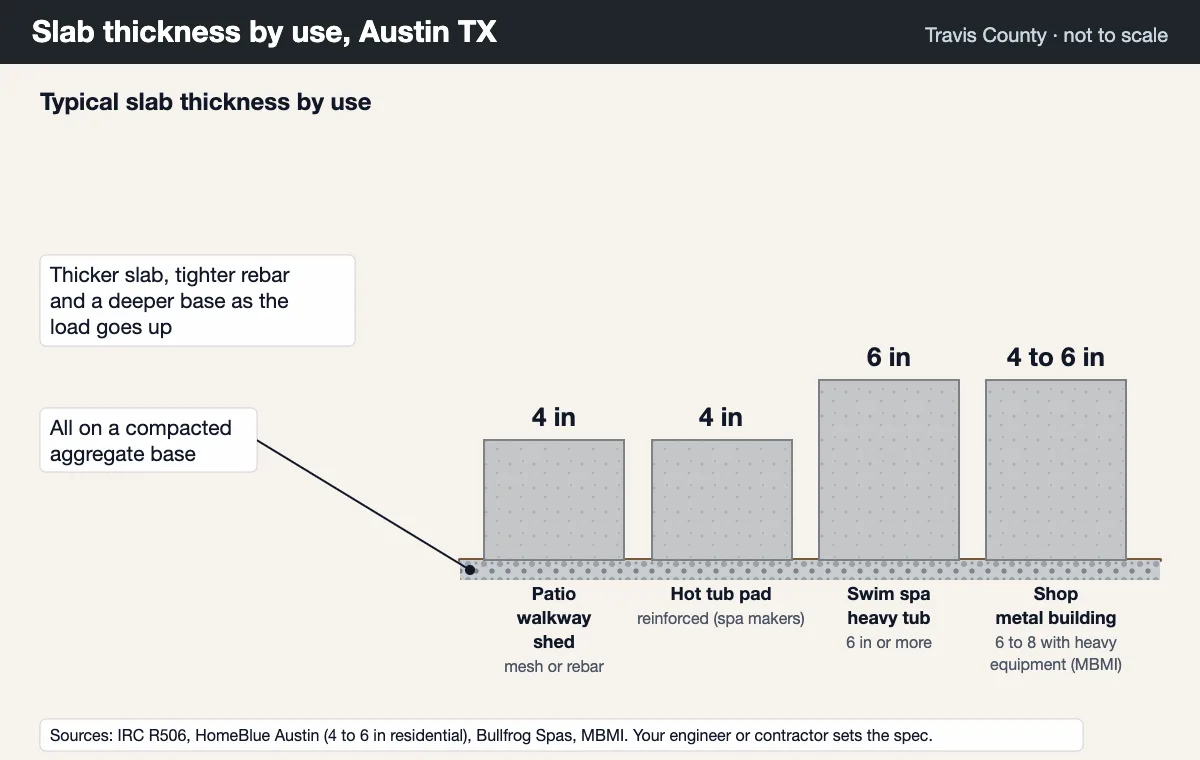
The quick rule: size the pad to whatever sits on it plus a margin, about 4 inches thick for foot traffic and light equipment, thicker where weight concentrates. This table pulls together what the sources on this site say for each use.
| Pad use | Thickness | Size | Notes |
|---|---|---|---|
| AC condenser or heat pump | About 4 in | Maker's footprint plus clearance | Level; slope away from the house |
| Standby generator | About 4 in or per maker | Maker's footprint plus clearance | Maker's install sheet sets the pad |
| Trash and recycling bins | About 4 in | Room for the carts plus a step | Often tied to a driveway or side yard |
| Walkway or steps landing | About 4 in | At least as wide as the door | Joints about every 10 ft (NRMCA CIP 6) |
| Hot tub | At least 4 in, reinforced | Bigger than the tub | Max 1/2 in slope over 8 ft (Bullfrog Spas) |
| Shed up to 200 sq ft | About 4 in | Shed footprint plus a few inches | No City building permit for the shed itself |
Swipe the table sideways to see every column →
Thickness ranges from HomeBlue's Austin guide (4 to 6 in residential) and Bullfrog Spas; joint spacing from NRMCA CIP 6. Equipment makers' installation sheets override any general figure.
How a concrete pad is installed
- 1Mark and dig
The pad outline is marked a few inches bigger than what sits on it, and the soil is dug out to make room for the base and the slab.
- 2Compact the subgrade
The exposed soil is compacted; soft pockets of clay come out and get replaced with base material.
- 3Base and forms
Crushed stone or other base goes in and is compacted, then straight forms are staked to the finished height with a slight fall away from the house.
- 4Steel
Wire mesh or rebar is set on chairs so it ends up inside the slab, not lying on the base.
- 5Pour, screed and finish
Concrete is placed, struck off level with the forms, floated, edged and given a broom or trowel finish.
- 6Joints and cure
Larger pads get control joints; every pad is kept moist or sealed with curing compound for the first days.
Concrete pad cost in Austin
Small pads are priced by the job more than by the foot. HomeBlue's Austin table lists a 3x3 pad at $100 to $180, a 5x5 at $200 to $400 and a 10x10 at $900 to $1,500 (September 2024). The general cost to pour a concrete slab in Austin page has the bigger sizes, and the slab calculator handles odd shapes broken into rectangles.
| Size | HomeBlue Austin (Sep 2024) | projectcosted Austin (Aug 2026) |
|---|---|---|
| 3x3 | $100 to $180 | not published |
| 5x5 | $200 to $400 | not published |
| 10x10 | $900 to $1,500 | $563 to $1,126 |
| Per sq ft, unreinforced pad | $5 to $10 | n/a |
| Per sq ft, slab installed | $6 to $10 (reinforced) | $5.63 to $11.26 |
Swipe the table sideways to see every column →
Pads, impervious cover and the City of Austin
A pad doesn't need a building permit, but it isn't invisible to the City either. The residential permit application's impervious cover worksheet has its own line for “AC pads and other concrete flatwork,” and every square foot counts toward the lot limit, generally 45 percent on SF-3 lots. On a lot near its cap, even a generator pad can matter. The Austin permit and impervious cover guide shows how to check.
Signs a pad is the right fix
- An AC condenser or generator is sitting on a sunken or tilted plastic pad
- Trash bins live on mud or gravel beside the house
- A walkway to a gate or side door turns to clay after rain
- A new shed, smoker or outdoor kitchen needs a level base
- An old pad has heaved and now drains water toward the slab of the house