
Last reviewed October 2026.
Concrete slab permits and impervious cover in Austin: the short answer
The City of Austin's list of work exempt from building permits includes, for residential property, “a sidewalk, driveway, or concrete flatwork that is not located in the public right-of-way.” That covers most patios, pads, parking pads and driveway widenings. What it doesn't cover:
| Work | Building permit? | Other approval |
|---|---|---|
| Patio, pad, walkway, private driveway widening | No (exempt flatwork) | Counts toward impervious cover |
| Driveway approach, curb, gutter or sidewalk work | No | Driveway/Sidewalk (DS) permit; ROW contractor's license |
| Shed up to 200 sq ft, 15 ft, no plumbing, not in a flood hazard area | No | Slab still counts toward impervious cover |
| Garage, carport or shop over 200 sq ft | Yes, with the slab on the plans | Building coverage and impervious cover |
| House or addition slab foundation | Yes | Foundation plan showing the reinforcing steel |
| Retaining wall over 4 ft, or with a surcharge | Yes | Under 4 ft with no surcharge is exempt |
| Any permitted work within 100 ft of the 100-year floodplain | Yes | Floodplain review |
Swipe the table sideways to see every column →
From the City of Austin's Work Exempt from Building Permits page, Right-of-Way Permits page and Residential New Construction and Addition Permit Application (11/14/22), read October 2026.
Impervious cover in Austin: how a slab is counted
Impervious cover is the total area of surfaces that keep rain from soaking into the ground. The City's residential permit application spells out what goes on the worksheet, and concrete is on almost every line.
| Worksheet line | Counts toward impervious cover |
|---|---|
| House, garage, carport, covered patio and porch (building coverage) | 100% |
| Driveway | 100% |
| Sidewalks | 100% |
| Uncovered patio | 100% |
| Uncovered wood deck with gaps, over soil | 50% |
| AC pads and other concrete flatwork | 100% |
| Pool coping and retaining walls | 100% |
| Pool, spa, pond or fountain water surface | Not counted |
| Gravel over soil used only for landscaping or by pedestrians | Not counted |
Swipe the table sideways to see every column →
City of Austin Residential New Construction and Addition Permit Application (11/14/22), impervious cover definition under LDC 25-1-23.
The limits by zoning
| Zoning | Impervious cover max | Building coverage max |
|---|---|---|
| SF-1 | 40% | 35% |
| SF-2 | 45% | 40% |
| SF-3 | 45% | 40% |
| SF-4B | 60% | 40% |
| SF-5, SF-6 | 55% | 40% |
Swipe the table sideways to see every column →
Summary of Land Development Code 25-2-492 as published by kiligray.com (August 2026). Watershed rules in LDC Chapter 25-8 can set lower limits; the lower number applies. Confirm your lot's zoning on the City's property profile.
Worked example
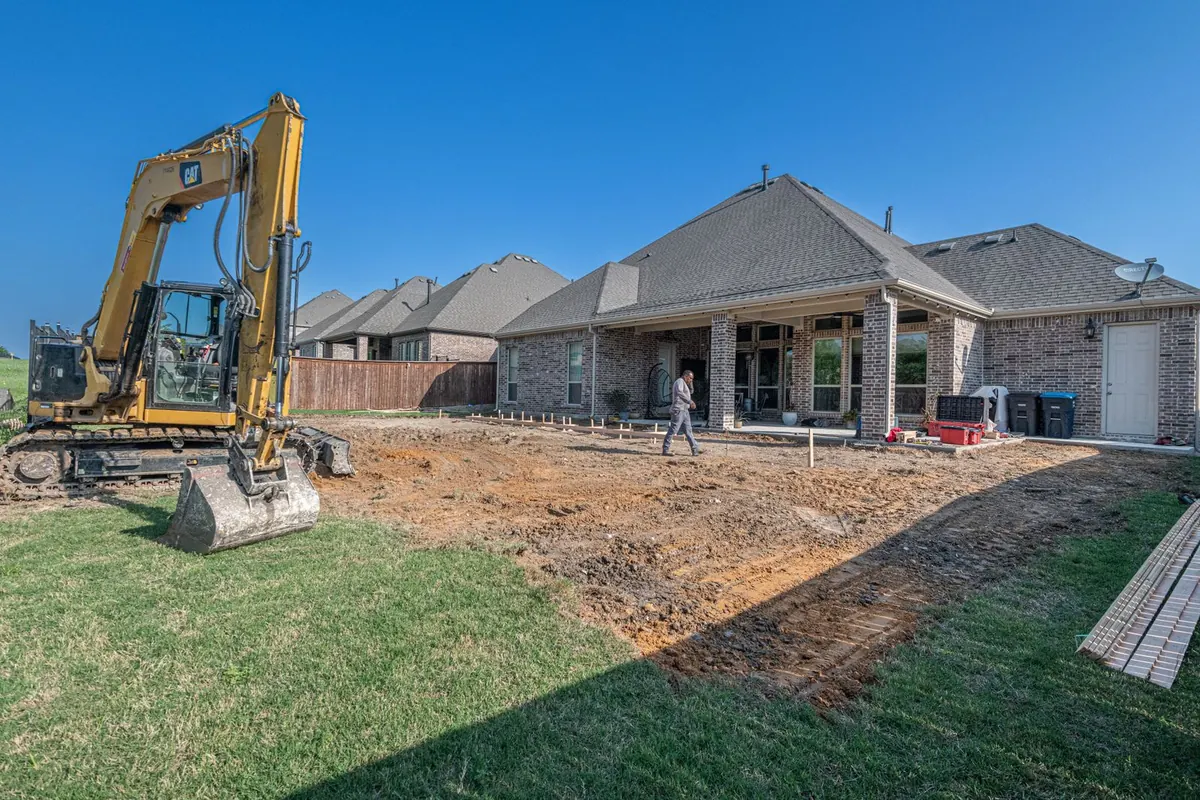
A 7,000 square foot SF-3 lot can have 3,150 square feet of impervious cover. A 2,000 square foot house footprint with a 450 square foot driveway and 120 square feet of walks uses 2,570. That leaves 580 square feet: enough for a 20x20 patio (400) and a 12x12 pad (144), but not a 20x30 patio (600) as well. Swapping part of the plan for a gapped wood deck, counted at half its area, is one way to make it fit.
Protected trees and slabs
Trees under 19 inches in diameter aren't regulated on residential property. For protected trees, the City allows no impacts in the inner quarter of the critical root zone, no more than 4 inches of cut or fill in the half critical root zone, and requires 50 percent of the full root zone to stay undisturbed. Removing the tree, pruning a quarter or more of the canopy, or disturbing the root zone needs a Tree Ordinance Review Application. The City's permit application adds that foundations can't meet the 4 inch rule, so they stay out of the half root zone entirely.
Floodplain and erosion review
Permitted work within 100 feet of the 100-year floodplain gets floodplain review, and properties in the City's Erosion Hazard Zone get a structural review. The City points to ATXFloodPro for checking a property. FEMA's map service shows the federal flood zones.
Outside city limits: Travis, Williamson and Hays counties
County rules work differently. Travis County's permit desk lists permits for single-family residences and duplexes, driveways, on-site sewage facilities, fences and retaining walls, demolition and clearing, and requires a development permit for new structures. Under Texas Local Government Code Chapter 233, Subchapter F, counties that adopt it apply the IRC to new single-family houses in unincorporated areas, with inspections at the foundation stage before concrete is placed, but they can't require prior approval or charge a fee for those inspections. A city's building code applies instead inside its extraterritorial jurisdiction if the city adopted one there.

Permit checklist before a slab goes in
- Zoning and lot size, so you know the impervious cover cap
- Existing impervious cover: house, drive, walks, patios, pads
- Whether any new concrete touches the curb, gutter or sidewalk
- Trees 19 inches or larger in diameter near the work
- Floodplain or erosion hazard status of the lot
- HOA design approval, which the City's exemption doesn't replace