Last reviewed October 2026.
Pouring concrete in Austin heat: the numbers
Austin gets about four weeks a year at or above 100 F, mostly in July and August. These are NOAA's 1991 to 2020 normals for Camp Mabry, the city's long-running weather station:
| Month | Normal high | Days 90 F+ | Days 100 F+ | Rain |
|---|---|---|---|---|
| May | 86.9 F | 11.1 | 0.3 | 5.04 in |
| June | 93.2 F | 23.8 | 3.1 | 3.68 in |
| July | 96.6 F | 29.0 | 9.5 | 1.96 in |
| August | 97.8 F | 29.2 | 13.3 | 2.74 in |
| September | 91.4 F | 20.0 | 2.6 | 3.45 in |
| October | 82.5 F | 6.4 | 0 | 3.91 in |
Swipe the table sideways to see every column →
NOAA NCEI 1991-2020 monthly normals, station USW00013958. Year: 122.8 days at or above 90 F, 28.7 at or above 100 F, 11.9 nights at or below 32 F, 36.25 in of rain.
What heat does to fresh concrete
Hot weather is more than air temperature. ACI 305R, as quoted in NRMCA's CIP 12, defines it as any combination of high air temperature, high concrete temperature, low humidity, high wind and sun that speeds moisture loss and cement hydration. The effects NRMCA lists:
- More water needed for the same slump, which raises the water-cement ratio and lowers strength
- Faster slump loss and faster setting, so finishing has to move quicker
- Plastic shrinkage cracks when the surface dries before the concrete sets
- Thermal cracking when a hot day is followed by a cool night
- Lower strength later on for concrete cured hot than for concrete cured around 70 F
How a summer pour is run in Austin
- 1Schedule around the heat
Book the pour for early morning and plan for the trucks to discharge on arrival. NRMCA advises avoiding the hottest part of the day for placing and finishing.
- 2Ask about the mix
Water-reducing and set-retarding admixtures, chilled water or ice in the mix, and supplementary materials like fly ash or slag cement all help in hot weather.
- 3Prepare the site
Dampen the base without leaving standing water, set up shade or windbreaks if it's hot, dry and windy, and have enough people on hand to place and finish without delay.
- 4Place and finish without adding water
NRMCA says not to sprinkle water on the surface to help finishing; fog or evaporation retarders protect the surface instead.
- 5Cure right away
Start curing immediately after finishing and keep it up for 3 to 7 days: wet curing, covers or a curing compound.
Austin humidity swings
NRMCA notes that high humidity tends to reduce the effects of heat. Austin's humidity varies with the wind: moist Gulf air on southeast winds, dry air on westerlies. A hot, dry, breezy afternoon is the worst case for a fresh slab surface, and that's when shade, windbreaks and fogging earn their keep.
Curing in the heat
Curing is keeping the new slab moist and at a good temperature while it gains strength. NRMCA's CIP 11 says it starts immediately after finishing and typically lasts 3 to 7 days, and that concrete in a dry environment can lose as much as 50 percent of its potential strength compared with moist-cured concrete.
| Method | How it works | Hot weather note |
|---|---|---|
| Fogging or sprinkling | Keeps the surface wet continuously | Excellent, if it never dries out between passes |
| Ponding | Water held on the slab by a small dam | The most thorough water cure |
| Wet coverings | Burlap or curing blankets kept damp | Re-wet often in the sun |
| Plastic sheeting | Traps the slab's own moisture | Weight the edges so wind can't lift it |
| Curing compound | Sprayed membrane that seals moisture in | Apply right after finishing |
Swipe the table sideways to see every column →
Alternate wetting and drying is not an acceptable curing practice, per NRMCA.
Joints come sooner in the heat
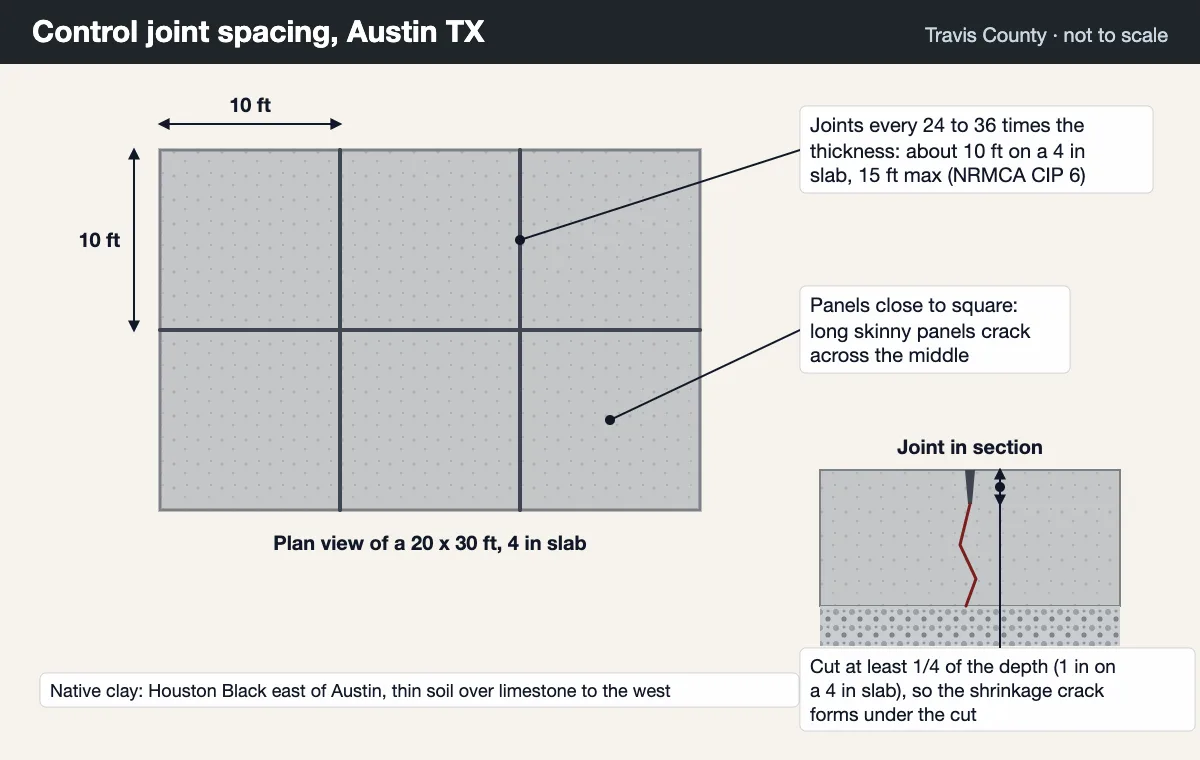
NRMCA's joint guidance says conventional saw cuts go in within 4 to 12 hours after finishing; hot weather speeds setting, which pulls that window earlier. Saw too late and the slab picks its own crack lines.